


Roofing in Southern California commercial construction demands a strategic approach shaped by the region’s unique climate, regulatory environment, and long-term performance expectations. With intense sun exposure, fluctuating temperatures, and minimal but occasionally heavy rainfall, roofing systems must be designed to withstand UV degradation, thermal expansion, and efficient water drainage. Materials and installation methods are not just about immediate protection—they directly impact energy efficiency, maintenance costs, and overall building lifespan.
Beyond environmental factors, commercial roofing projects in this region must also account for strict building codes, sustainability initiatives, and energy compliance standards such as Title 24. Reflective roofing materials, proper insulation, and drainage design play a critical role in reducing heat absorption and improving operational efficiency. For developers and property owners, the roof is more than a structural component—it’s a long-term investment that influences performance, compliance, and cost control for years to come.
Here are the key areas every facilities manager needs to address:
Southern California's commercial roofing environment is one of the most demanding in the United States. You're dealing with intense UV exposure, extreme heat cycles in the Inland Empire, wildfire risk across large parts of the region, and some of the strictest energy and building codes in the country.
For facilities managers overseeing large or multi-site commercial properties, getting roofing decisions wrong is costly. A poorly specified system can fail years ahead of schedule, trigger code violations, or void manufacturer warranties.
This guide walks through every major factor — from regulatory compliance and material performance to budgeting and long-term maintenance — so you can make confident, data-driven decisions for your California properties.
Navigating the regulatory landscape in California can feel like a full-time job. Between state-wide mandates and local municipal requirements, we must ensure every project meets a high bar for safety and efficiency.
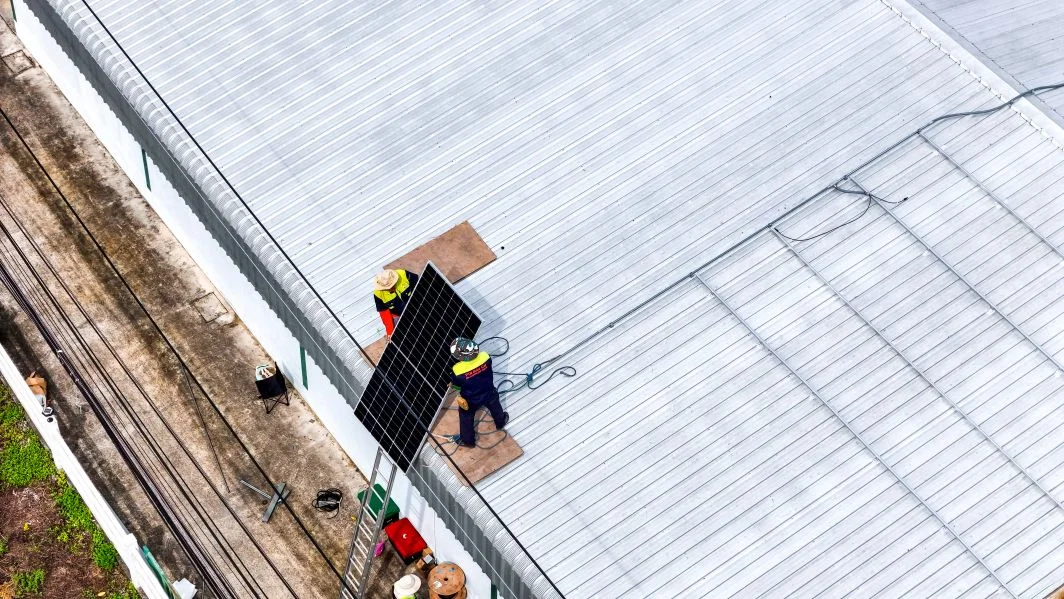
The foundation of any project is the California Building Code (CBC). The CBC is updated on a triennial cycle, adopting and amending international standards to fit California's unique geography. For commercial roofing, this means strict adherence to standards for roof framing, impact resistance, and drainage. For example, flat roof systems must have engineered internal drainage networks—including drains, overflow drains, and scuppers—calibrated to handle a 100-year storm event per CBC Section 1503.
In California, any roofing project exceeding $500 in combined labor and materials requires a valid license from the California Contractors State License Board (CSLB). Contractors typically hold a C-39 (Roofing) license. It is a common misconception that small commercial repairs are exempt; however, commercial replacements generally require permits regardless of square footage.
The permitting process involves submitting stamped plans to the local Authority Having Jurisdiction (AHJ). This ensures the proposed system can handle the structural load and meets local zoning requirements. At RSVC, we prioritize compliance and risk management to ensure operational excellence for every client.
If there is one term that dominates Roofing Considerations in Southern California Commercial Construction, it is Title 24. Specifically, Title 24, Part 6 (the California Energy Code) mandates "cool roof" standards for nonresidential buildings.
A cool roof is designed to reflect more sunlight and absorb less heat than a standard roof. This is measured by two key metrics:
In many Southern California climate zones, such as the Inland Empire (Climate Zone 10), low-slope commercial roofs must meet a minimum aged solar reflectance of 0.63 and a thermal emittance of 0.75. These materials must be rated by the Cool Roof Rating Council (CRRC).
Compliance isn't just about following the law; it’s about the building envelope. A high-performing roof can reduce cooling loads by 20-30%, which is a massive win for your operational budget.
Fire safety is not a suggestion in California—it is a survival requirement. The California Department of Forestry and Fire Protection (CAL FIRE) designates State Responsibility Areas and Very High Fire Hazard Severity Zones (VHFHSZ).
If your property sits within these zones, the CBC requires Class A fire-rated roofing assemblies. This is the highest classification, tested under ASTM E108 or UL 790 to provide maximum protection against fire spread. Materials like metal, clay tiles, and specific mineral-surfaced membranes are often used to achieve this rating.
Seismic Anchorage and Structural LoadSouthern California is earthquake country. The CBC mandates specific seismic anchorage for roofing components to ensure they stay attached during a tremor. Furthermore, when we consider re-roofing older buildings, we must evaluate the structural load. Adding a new layer of roofing or heavy insulation can exceed the original engineered margins of a 1970s or 80s warehouse. In these cases, a structural engineer must verify that the building can support the weight of modern, code-compliant materials.
Choosing the right roofing material in Southern California is a careful balancing act between upfront investment, projected lifespan, and the ability to withstand a demanding environment. Under relentless sun exposure, UV degradation becomes the primary adversary of nearly every roofing membrane, gradually breaking down materials and compromising performance over time.
This makes durability and reflectivity critical considerations, not just for longevity but also for energy efficiency. Materials that can resist prolonged UV exposure while minimizing heat absorption help reduce cooling loads and extend the roof’s functional life. In a region where conditions are consistently harsh, selecting the right system upfront can significantly lower maintenance costs and prevent premature replacement.
Comparison of Common Systems (2026 Projections)
| Material | Typical Service Life | SRI Value | Best Use Case |
|---|---|---|---|
| TPO | 15–25 Years | High (80-90) | Warehouses, Retail |
| PVC | 20–30 Years | High (80-100) | Restaurants, Industrial |
| Mod-Bit | 15–20 Years | Variable | High-traffic roofs |
| Coatings | 10–20 Years | Very High (100+) | Restoration/Cooling |
Location matters. A roof in Riverside faces vastly different stressors than one in Anaheim or Santa Monica.
The Inland Empire ChallengeIn areas like Ontario and San Bernardino, thermal cycling is the biggest threat. Temperatures can swing 40 to 50 degrees in a single day. This causes materials to expand and contract rapidly, which can stress seams and flashings. In these zones, we recommend highly flexible membranes like TPO or PVC with heat-welded seams, which are stronger than taped seams.
The Coastal ChallengeNear the coast, the primary concerns are salt spray and high humidity. Salt air is corrosive to metal components, including fasteners and flashings. For coastal properties, using stainless steel fasteners or specialized coatings is essential to prevent premature rust and failure. Additionally, wind uplift ratings are critical for buildings near the ocean where gusty conditions are more frequent.
When a roof nears the end of its life, owners face a choice: tear it off or cover it up?
Budgeting for Roofing Considerations in Southern California Commercial Construction requires looking beyond the price of the membrane. In 2026, labor costs in Los Angeles and Orange County continue to trend above national averages due to the high cost of living and strict Cal/OSHA safety requirements.
At RSVC, we focus on helping our partners achieve steady revenue growth by improving cost management. We believe that a strategic approach to construction avoids the "cheapest bid" trap, which often leads to expensive repairs later.
The high cost of California roofing is offset by several financial incentives. Property owners should investigate:
We always recommend a 10-15% contingency fund. In Southern California, it is common to find hidden termite damage or dry rot once the old roof is removed—surprises that are better handled with a pre-allocated budget.
A commercial roof is an asset, not just a expense. Research shows that properties with consistent semi-annual maintenance programs realize 30-50% longer service lives than neglected roofs.
Effective infrastructure decisions involve a proactive maintenance schedule:
Waiting for a leak to appear in the lobby is a recipe for disaster. Facilities managers should look for these early warning signs:
We often use infrared scanning to detect moisture trapped beneath the surface. This allows us to perform surgical repairs rather than a full replacement, saving our clients tens of thousands of dollars.
The most common signs include recurring leaks that repairs can't fix, widespread ponding water, visible cracks or "alligatoring" in the membrane, and an age exceeding 20 years. If your annual maintenance and repair costs exceed 10-15% of the total replacement cost, economic analysis usually favors a full replacement.
Title 24 essentially mandates that you choose materials with high solar reflectance and thermal emittance. This limits your choices to white or light-colored membranes (TPO/PVC), specialized "cool" cap sheets for modified bitumen, or reflective coatings. Using a non-compliant material can lead to failed inspections and the denial of your certificate of occupancy.
Any contractor performing work over $500 must hold a valid license from the CSLB. For roofing, this is typically a C-39 license. At RSVC, we ensure all our partners and teams are fully licensed, bonded, and insured to protect our clients' assets and ensure compliance with California Labor Code Section 1720.
At RSVC, we understand that renovating or building a commercial property is a journey, not a single event. Whether you are managing a property in Southern California or elsewhere in the state, the pressure to adapt, modernize, and optimize operations is real—but with change comes opportunity.
Our approach focuses on operational excellence, innovative solutions, and strategic partnerships to ensure every project delivers maximum value. By combining careful planning, expert construction management, and cutting-edge technology, we help clients transform their facilities into efficient, functional, and sustainable spaces. From initial design through project completion, we prioritize quality, safety, and reliability to keep every project on schedule and within budget.
Operational excellence drives everything we do. Our team is equipped to manage complex commercial projects of all sizes, ensuring that construction and renovation processes are seamless and disruption is minimized. By anticipating challenges, coordinating trades effectively, and applying proven best practices, we help clients achieve spaces that operate smoothly from day one.
Ready to start your next project with a partner you can rely on? More info about construction services is just a click away. Let's build something great together—on time, and on budget.


