


Accessible design is more than a regulatory requirement—it is a reflection of how your business values inclusion, safety, and community engagement. ADA-compliant sidewalks and entrances ensure that every customer, employee, and visitor can access your property with confidence and dignity. From properly graded walkways and curb ramps to compliant door widths and threshold transitions, these features create a welcoming first impression while reducing liability risks.
Beyond meeting the standards established by the Americans with Disabilities Act (ADA), investing in compliant exterior access points strengthens your brand reputation and broadens your customer base. Businesses that prioritize accessibility demonstrate professionalism, foresight, and social responsibility—qualities that resonate with today’s consumers and tenants. In competitive commercial environments, ADA-compliant sidewalks and entrances are not just about avoiding penalties; they are about building a property that works for everyone.
Here's a quick summary:
| Reason | What It Means for You |
|---|---|
| Legal requirement | The ADA mandates accessible sidewalks and entrances for most businesses |
| Large customer base | About 26% of U.S. adults have a disability — that's a significant portion of your foot traffic |
| Financial exposure | Non-compliance can lead to lawsuits, fines, and costly retrofits |
| Tax benefits | Qualifying upgrades may earn up to $5,000 in tax credits |
| Reputation | Accessible businesses signal inclusivity and professionalism |
More than 50 million Americans — roughly 18% of the population — live with some form of disability. People with disabilities also collectively control $1 trillion in annual income. That's a customer group no business can afford to ignore. And it's not just about customers today. By 2030, an estimated 71.5 million baby boomers will be over age 65, bringing age-related mobility needs with them.
For businesses, ensuring accessibility isn't just a matter of good service — it's the law.
Non-compliant sidewalks and entrances can silently exclude a large share of potential customers, expose your organization to legal action, and damage your reputation. The good news is that understanding the requirements and taking the right steps makes compliance achievable.
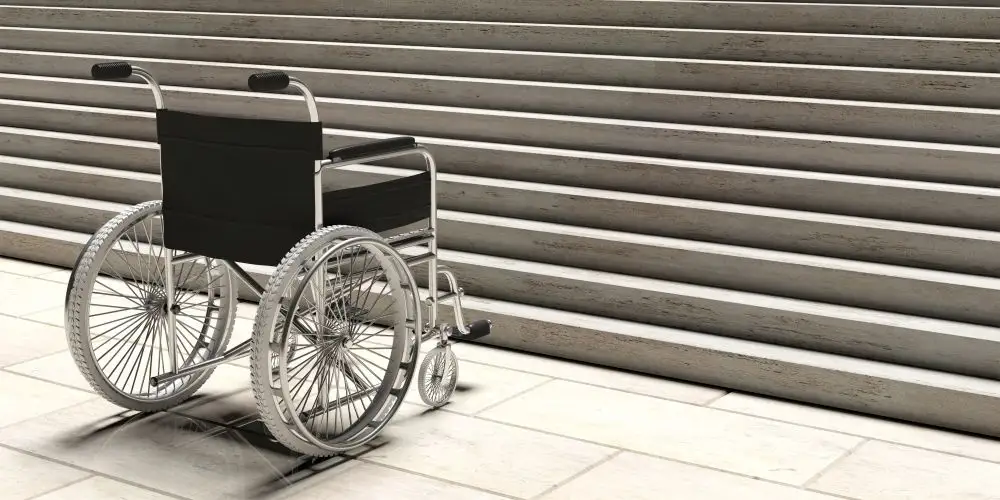
The Americans with Disabilities Act (ADA), enacted in 1990, is a federal civil rights law that prohibits discrimination against individuals with disabilities. For us in the business world, the most critical section is Title III. This section focuses on "public accommodations"—privately owned businesses that provide goods or services to the public—and "commercial facilities," such as office buildings or warehouses.
One of the most important concepts for existing businesses is "readily achievable" barrier removal. This means that if your building was constructed before the current standards took effect, you are still required to remove architectural barriers if doing so is "easily accomplishable and able to be carried out without much difficulty or expense." What is considered "readily achievable" varies from one business to another based on its size and financial resources. However, the Department of Justice (DOJ) makes it clear that accessibility is a continuing obligation. You can't just "set it and forget it."
If you run a business in California, chances are you need to be ADA compliant. The law covers a wide range of entities, including:
Essentially, if your doors are open to the public, you are likely a "place of public accommodation." Even if you operate a private office that doesn't see many "walk-in" customers, you are still classified as a commercial facility and must follow ADA standards for any new construction or alterations.
To understand the importance of ADA-compliant sidewalks and entrances for your business, you have to start with the concept of the “accessible route.” This refers to the continuous, unobstructed path that connects all accessible elements and spaces within a building or facility. If a customer cannot travel safely and independently from their vehicle or the public sidewalk to your front door, the accessibility features inside your building become irrelevant.
An accessible sidewalk must be:
For a deeper dive into making your property accessible, check out our guide on Accessibility Upgrades for Your Office Building.
Once a customer reaches your door, the Opening Doors To Everyone guidelines take over. A compliant entrance isn't just about having a wide door; it’s about the mechanics of how that door operates.
Key technical requirements include:
Curb ramps are the bridge between the street and the sidewalk. They are often the site of common violations. A compliant curb ramp must have a slope no steeper than 8.33% (1:12). If the ramp has flared sides where pedestrians might walk across them, those flares can't be steeper than 10%.
One of the most visible parts of an ADA-compliant sidewalk is the detectable warning surface. These are the bright (usually yellow) tiles with raised "truncated domes" found at the bottom of curb ramps. They serve as a tactile warning for individuals with visual impairments, letting them know they are about to enter a vehicular way. These surfaces must contrast visually with the surrounding pavement—dark-on-light or light-on-dark.
Beyond the technical jargon, ADA-Compliant Sidewalks and Entrances come down to people. When we prioritize accessibility, we aren't just checking a box for a building inspector; we are welcoming a massive segment of the population.
Consider these facts:
The government actually helps us foot the bill for these improvements. There are two primary Tax incentives available:
In California, we have some of the strictest accessibility laws in the nation. The California Building Code (Title 24) often goes above and beyond federal ADA requirements. For example, while the federal standard for a path of travel is 36 inches, California often requires a 48-inch wide path in many commercial settings.
Common violations we see in cities like Los Angeles, San Diego, and Sacramento include:
To protect your business from "drive-by" ADA lawsuits, we highly recommend hiring a Certified Access Specialist (CASp). A CASp is a professional who has passed an examination and is certified by the State of California to review buildings for compliance with state and federal accessibility standards.
Having your property inspected by a CASp provides "qualified respondent" status. This means that if you are sued for an ADA violation in a California state court, you are entitled to certain legal protections, such as a stay of proceedings and an early evaluation conference. It shows the court that you are making a good-faith effort to be compliant.
"Readily achievable" means easily accomplishable without much difficulty or expense. For a large corporation, installing a $20,000 ramp might be readily achievable. For a small "mom and pop" shop, it might not be. However, the shop might still be required to provide alternative services, like curbside pickup, if they can't make the entrance accessible.
No, the ADA Standards do not require automatic doors. However, they are highly recommended because they solve many problems at once—operating force, maneuvering clearance, and closing speed. If you choose not to use automatic doors, you must ensure your manual doors meet all the hardware and force requirements.
We recommend a professional assessment at least once every two years, or whenever you notice changes in your concrete. In Southern California, seismic activity and heat can cause concrete to shift and crack faster than in other regions. Routine maintenance is much cheaper than a lawsuit.
At RSVC, we believe that accessibility is more than just a legal hurdle—it's an opportunity to build a better, more inclusive business. From the initial design phase to long-term maintenance, ensuring your sidewalks and entrances meet ADA standards is a smart investment in your company's future.
At RSVC, we pride ourselves on being a leader in facilities management and commercial construction. Our approach combines digital innovation with a customer-centric focus to deliver solutions that actually work for your specific building. From the initial audit to the final commissioning, we leverage technology and top-tier talent to ensure your HVAC system is an asset, not a drain.
Ready to transform your building's performance? Contact RSVC for your next commercial construction project and let us help you steer the path to a more efficient, comfortable, and sustainable future.


